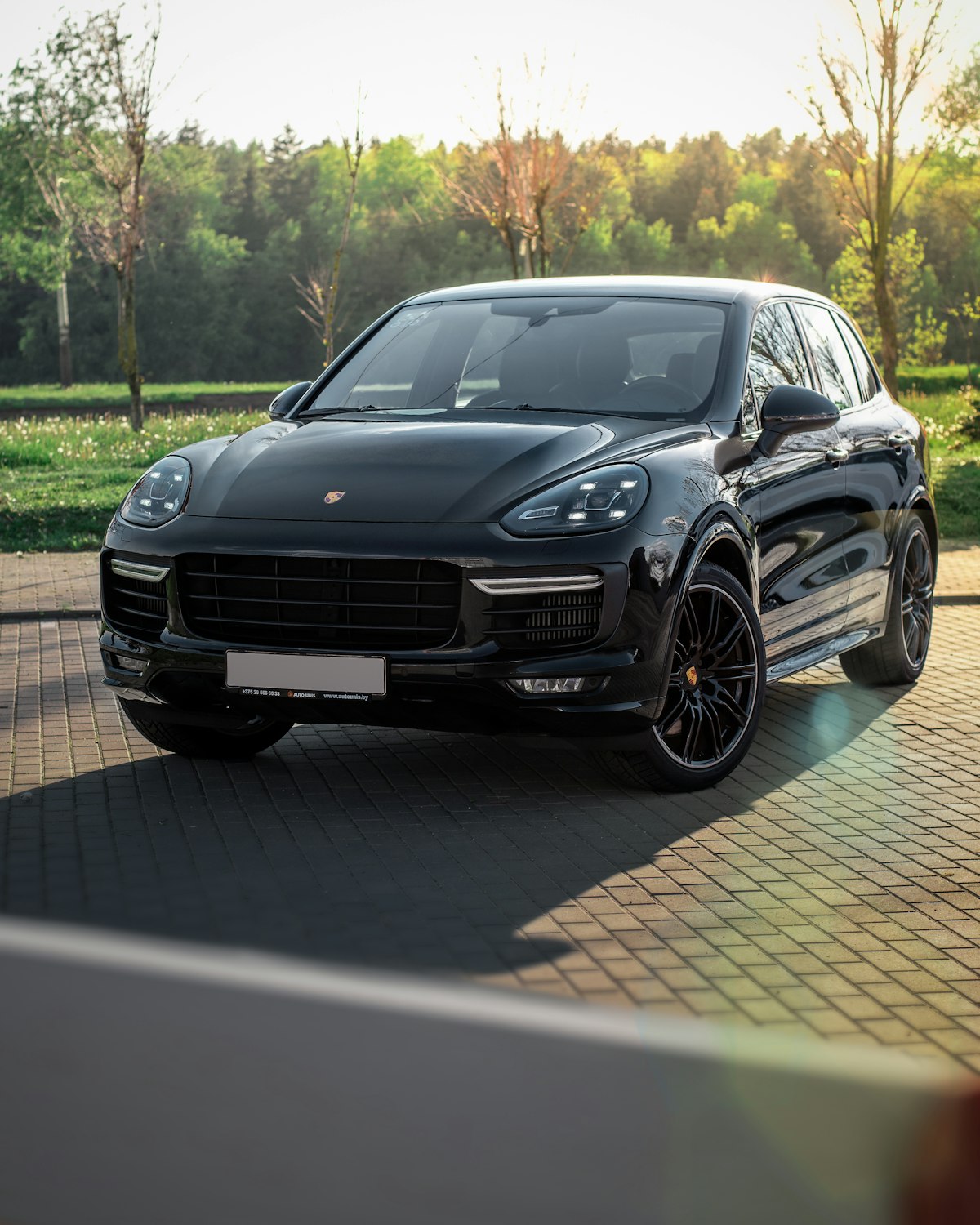
There's a particular kind of silence that defines the new Cayenne. It's not the absence of sound—Porsche's engineers have tuned a subtle, synthetic thrum that enters the cabin above 50 mph—but rather the absence of the familiar flat-six or turbocharged V8 that has defined this nameplate for over two decades. In its place: 603 horsepower from dual permanent-magnet synchronous motors, 800-volt architecture shared with the Taycan, and a 108 kWh battery that Porsche claims will deliver 385 miles of real-world range.
Let's address the number that matters most first: 2,410 kg. That's the kerb weight of the Cayenne EV in Turbo specification. It's heavy. There's no engineering trick that can fully disguise the mass of a large SUV carrying a battery pack the size of a dining table beneath its floor. But what Porsche has done—and done remarkably well—is manage that mass.
Chassis & Dynamics
The new Cayenne rides on Porsche's Premium Platform Electric (PPE) architecture, shared with the Macan EV, but stretched and reinforced for the larger vehicle. The battery pack is structural, contributing to a torsional rigidity that Porsche claims is 25% greater than the outgoing ICE Cayenne. The centre of gravity sits 68mm lower than the combustion model—a difference you feel within the first hundred metres.
The adaptive air suspension, standard on all Cayenne EV variants, offers 90mm of ride height adjustment. In its default setting, the Cayenne floats over German B-roads with a composure that borders on otherworldly. Select Sport+ mode, and the car drops 22mm, the dampers firm considerably, and the rear-axle steering—up to 5.5 degrees of opposite lock at low speeds, 2.8 degrees of same-direction lock above 80 km/h—transforms the turning circle and high-speed stability.
On the Road
The route Porsche laid out for our first drive was deliberate: a mix of unrestricted autobahn, tight Swabian hillside roads, and the kind of broken urban surfaces that expose suspension shortcomings. Through all of it, the Cayenne EV felt like the most resolved large electric SUV I've driven.
The steering, always a Porsche strength, is excellent. There's genuine texture through the rim—not the artificial resistance that some electric SUVs dial in—and the front axle responds to inputs with a precision that belies the car's mass. Turn-in is crisp, mid-corner adjustability is confidence-inspiring, and the torque vectoring system, which individually brakes each wheel, effectively rotates the car out of tight bends without drama.
"We had a clear benchmark: the Cayenne Turbo GT. The EV had to match or exceed it in every dynamic discipline. We believe it does."
— Thomas Friemuth, Vice President Cayenne Model Line
On the autobahn, the Cayenne EV pulls cleanly to its electronically limited 260 km/h top speed with a relentlessness that internal combustion simply cannot match. There's no gearshift interruption, no turbo lag, just a continuous, massive thrust that pins you firmly into the 18-way adjustable seats. The 0-100 km/h sprint takes 3.6 seconds—impressive for a vehicle of this size, though the number alone undersells the experience.
Range & Charging
Porsche claims 385 miles on the WLTP cycle, but the more relevant figure for enthusiast drivers is the real-world consumption we observed: approximately 3.1 miles per kWh in mixed driving with the air conditioning running and the drive mode set to Sport. That translates to roughly 335 miles of real-world range—still comfortably enough for most use cases.
Charging performance is where the 800-volt architecture earns its keep. We observed a peak charging rate of 320 kW on a compatible 350 kW charger, with the 10-80% charge completing in just under 21 minutes. Even on a 150 kW CCS charger, the curve remained impressively flat, achieving 10-80% in approximately 38 minutes.
Interior & Technology
The cabin is quintessentially Porsche: driver-focused, material-rich, and free from the minimalist-for-its-own-sake design language that defines some competitors. Physical buttons for climate and drive mode selection sit beneath a curved 12.6-inch driver display and a 10.9-inch central touchscreen. The optional passenger display adds a third screen, but it's the head-up display—now augmented reality, projecting navigation arrows onto the real road ahead—that steals the technology show.
The Bottom Line
The electric Cayenne is not a compromise. It is, in almost every measurable way, a better vehicle than the combustion model it replaces. Faster, quieter, more refined, more technologically sophisticated, and—critically for the driving enthusiasts in Porsche's customer base—more dynamically capable than any electric SUV on sale today.
At €98,500 for the base model and €142,800 for the Turbo we tested, it's not inexpensive. But for those who understand what Porsche has achieved here—taking a two-and-a-half-tonne electric SUV and making it feel like a sports car—the price feels justified. The Cayenne EV isn't just the most important Porsche since the original Cayenne saved the company in 2002. It might be the most important electric vehicle of the decade.