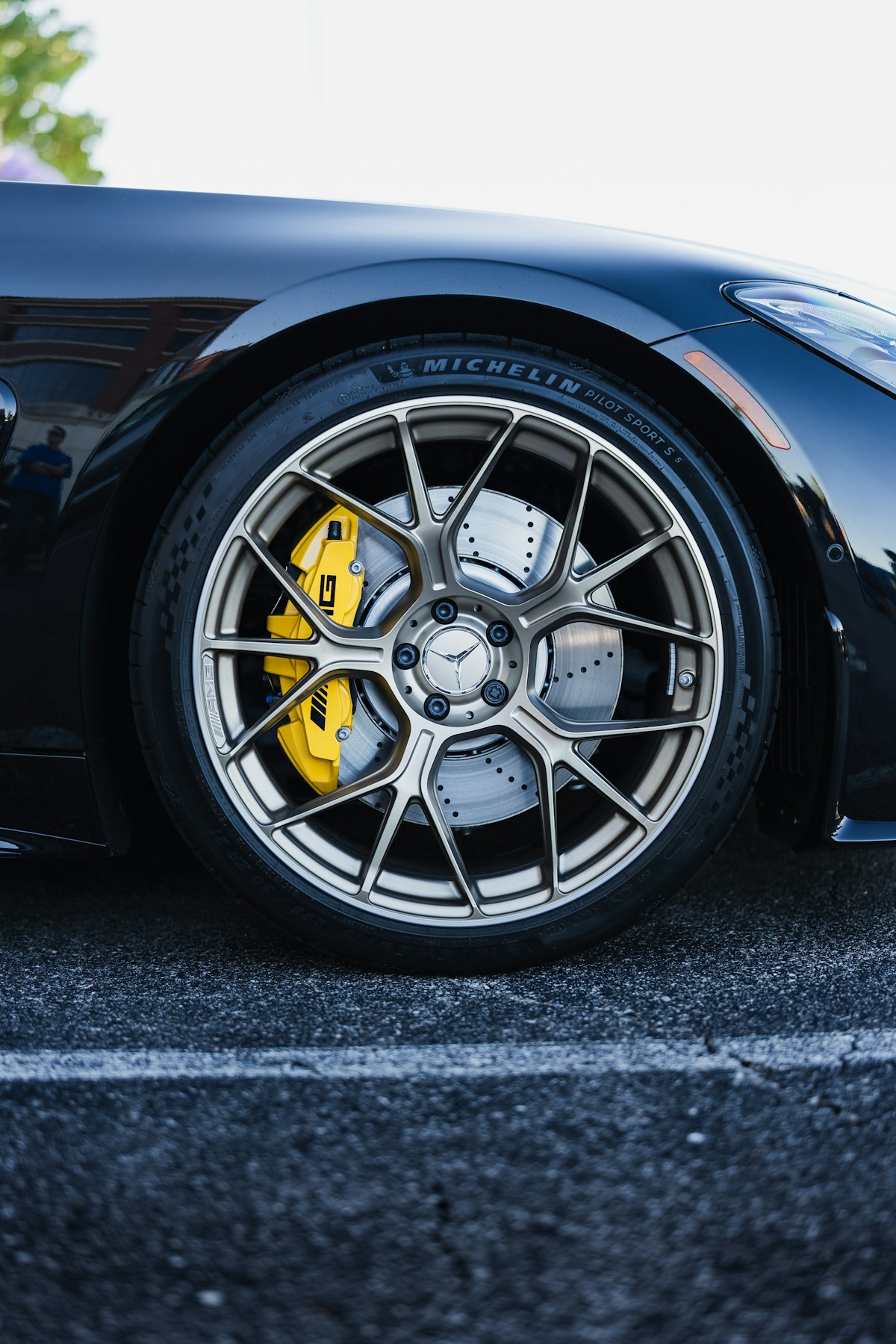
Carbon-ceramic brake discs are one of the most misunderstood technologies in the automotive world. They're marketed as a premium upgrade—and priced accordingly, at £10,000-£15,000 for a set of four—but the actual engineering principles behind them are rarely explained clearly. Let's fix that.
What They're Made Of
A carbon-ceramic brake disc is not, as the name might suggest, simply made from carbon and ceramic bonded together. It is a Carbon fibre-Reinforced Silicon Carbide (C/SiC) composite—a material that begins life as chopped carbon fibres mixed with phenolic resin, and is transformed through a multi-stage manufacturing process that takes up to three weeks.
The process begins with the raw material: chopped carbon fibres approximately 5mm in length, mixed with powdered phenolic resin and a small quantity of silicon carbide particles. This mixture is compression-moulded at high pressure into the rough shape of a brake disc—a process called "green body" formation.
The green body is then heated in a nitrogen atmosphere to approximately 1,000°C, a process called carbonisation. The phenolic resin decomposes, leaving behind a porous carbon matrix reinforced with carbon fibres. At this stage, the disc is fragile—strong in compression but weak in tension.
The critical step follows: siliconisation. The porous carbon disc is placed in a vacuum furnace with molten silicon at 1,700°C. The silicon wicks into the porous structure through capillary action, reacting with the carbon to form silicon carbide (SiC) in situ. This reaction fills the pores and creates an extremely hard, thermally stable ceramic matrix that binds the carbon fibres.
Why They're Better
Heat resistance: Conventional cast iron discs begin to fade—losing friction coefficient—at temperatures above 700°C. Carbon-ceramic discs maintain consistent friction coefficients up to 1,000°C, with a structural integrity that allows operation at even higher temperatures. This is why they're mandatory in Formula 1 and LMP1/Hypercar classes, where brake temperatures routinely exceed 800°C during heavy braking zones.
Weight: A carbon-ceramic disc weighs approximately 50-60% less than an equivalent iron disc. For a high-performance car, this translates to a reduction of 15-20 kg in unsprung mass—mass that the suspension must control over bumps. Reducing unsprung mass improves ride quality, tyre contact, and overall handling responsiveness.
Longevity: In road use, carbon-ceramic discs can last 100,000-150,000 miles compared to 30,000-50,000 miles for iron discs. This extraordinary durability partially offsets their higher initial cost.
Why They're Expensive
The three-week manufacturing process, the vacuum furnace siliconisation step, and the quality control requirements (each disc is CT-scanned for internal voids) make carbon-ceramic discs inherently expensive to produce. Brembo, the dominant supplier, operates dedicated facilities in Stezzano, Italy, and Qingdao, China, with a combined annual capacity of approximately 100,000 discs—a fraction of the millions of iron discs produced globally each year.
For road car buyers, the cost-benefit calculation is nuanced. If you drive enthusiastically on track days, carbon-ceramics are a genuine performance upgrade that will outlast iron alternatives. For daily commuting, they're an expensive luxury that you'll rarely exploit. The engineering, however, is beyond reproach.